

What to Ask Your Barber Before the Cut
You sit down, your barber asks, "What are we doing today?" and suddenly every haircut term you thought you knew disappears. That moment matters more than most guys think. Knowing what to ask your barber can be the difference between a cut that looks sharp for two weeks and one that works from day one, fits your routine, and grows out properly.
A strong haircut starts before the clippers come out. The consultation is where shape, length, texture, maintenance, and personal style all get aligned. If you can ask clear questions, your barber can do better work for you. That does not mean you need to know every technical term. It means you need to know how to describe what you want and what you need the cut to do in real life.
What to ask your barber first
The best opening question is simple: "What haircut actually suits my hair and face shape?" That gives your barber room to guide you instead of forcing a style that looks good on someone else but not on you.
A lot of men come in with a reference photo and assume that is enough. Photos help, but they are only a starting point. Your barber still has to work with your hairline, density, growth pattern, crown, texture, and how much time you are willing to spend styling it each morning. A photo shows the finish. It does not show whether that cut makes sense for you.
You should also ask, "Will this style work with how my hair grows?" That question matters if you have strong cowlicks, a receding hairline, thick hair that pushes out at the sides, or finer hair that falls flat. A good barber will tell you where a style needs adjusting. Sometimes that means leaving more weight in one area. Sometimes it means avoiding a blunt fringe or taking a fade slightly lower so the shape stays cleaner.
Another smart question is, "How will this grow out?" Not every sharp cut ages well between appointments. Some styles look excellent for the first week, then lose shape quickly. Others are easier to maintain and still look strong as they grow. If you want consistency, this question is worth asking every time.
Ask about the sides, neckline, and finish
Most haircut problems happen because the client and barber were not specific enough about the details. Saying "short on the sides" can mean very different things depending on the person. One man means a tight skin fade. Another means a neat taper with some coverage.
Ask, "How short are we going on the sides?" and if needed, follow with, "Are we talking a taper, a low fade, a mid fade, or skin close?" You do not need to use barber language perfectly. You just need to narrow down the result.
The neckline matters too, especially if you wear collared shirts, keep your hair short, or want a cleaner look from behind. Ask whether a natural neckline or a sharper blocked finish makes more sense for your cut. A natural neckline often grows out softer and cleaner over time. A blocked neckline can look stronger at first but may show growth faster. Neither is automatically better. It depends on the look you want and how often you come in.
The same goes for sideburns. If you wear glasses, have a beard, or keep facial hair, your sideburn length and shape affect the whole balance of the cut. It is worth asking your barber to show you where they should sit.
If you wear a fade, ask better fade questions
A lot of clients ask for a fade without knowing there are several ways it can be built. If fades are part of your regular look, the right question is not just "Can I get a fade?" It is "What type of fade works best for my head shape, hair density, and usual style?"
A low fade gives a cleaner edge while keeping more weight and can feel more professional for everyday wear. A mid fade creates stronger contrast and often looks more defined from the front. A high fade is bolder, but it does not suit everyone, especially if the head shape or crown makes the transition look too exposed. A skin fade gives maximum sharpness, but it usually needs more upkeep than a softer fade done with some length left in.
This is where honesty helps. If you only want to come in every few weeks, ask your barber which fade will still look balanced as it grows. If you want a more polished finish all the time, that may mean booking more consistently.
What to ask your barber about the top
The top is where style lives. It is also where many men stay too vague. "Leave some length" does not tell your barber enough.
A better question is, "How much should we leave on top so I can style it the way I want?" If you slick your hair back, wear texture forward, part it to the side, or prefer a natural finish, that changes how much length should stay and where.
You should also ask, "Do I need weight removed, or do I need more structure?" Thick hair often needs debulking in the right places, but too much texturizing can make it frizzy or harder to control. Fine hair may need stronger shape and less aggressive thinning so it keeps density. Curly or wavy hair has its own rules again. Precision matters.
If you are growing your hair out, say that clearly and ask, "What can we clean up without setting back the growth?" That helps your barber refine the edges and shape while keeping your longer-term goal intact.
Ask about styling before you leave the chair
A haircut that only looks good in the shop is not a finished service. You want a cut you can manage on a workday, after the gym, or on a rainy Vancouver morning when your hair has other plans.
Ask your barber, "How should I style this at home?" Then go one step further and ask, "How long will that realistically take me?" There is no point wearing a cut that needs fifteen minutes of daily styling if you only want to spend two.
You should also ask what product suits your hair type and finish. Matte clay, paste, pomade, cream, powder, and sea salt spray all do different jobs. The right product depends on whether you want hold, movement, shine, texture, control, or a more natural look. It also depends on your hair density and length. A product that works well on thick straight hair can be the wrong choice for fine hair or loose curls.
This is also the moment to ask your barber to show you how much product to use. Most men either use too much and weigh the hair down or too little and wonder why nothing holds.
What to ask your barber if you have a beard
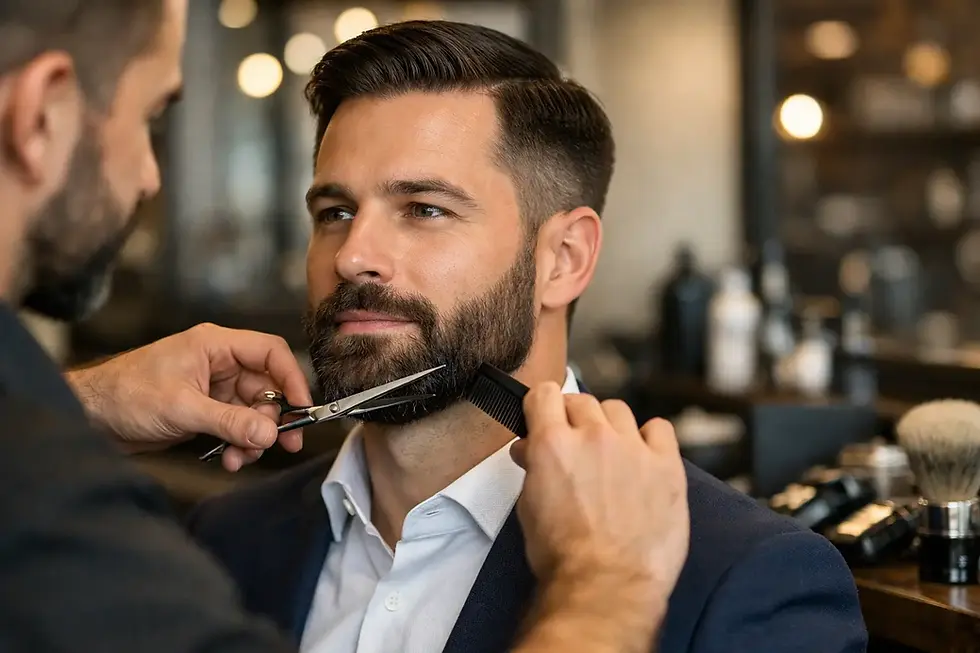
If you wear a beard, the haircut should not be treated separately. Ask, "How should my haircut and beard connect?" That question helps create a more intentional overall shape.
For some men, a tight transition from temple to beard looks clean and modern. For others, a softer blend keeps the look fuller and more balanced. Face shape matters here. So does beard density. If your beard is stronger in some areas than others, your barber can shape around that instead of fighting it.
You can also ask where your cheek line and neckline should sit. Small adjustments make a noticeable difference. The goal is not to make the beard look overdone. It is to make it look sharp, even, and suited to your features.
Bring reference, but ask for professional input
Photos help most when you use them properly. Instead of saying, "I want this exactly," ask, "What parts of this can work for me?" That invites your barber to translate the style rather than copy it blindly.
Be open to hearing that some elements should change. Maybe the fringe in the photo will not suit your hairline. Maybe the fade needs to sit lower. Maybe the top needs more length than the photo suggests because your hair shrinks when dry. A strong barber is not just following orders. He is shaping the cut to fit you.
At a professional shop, that conversation is part of the service. It is one reason clients who value consistency keep coming back. When the consultation is clear, the result is cleaner, more wearable, and easier to maintain.
The goal is not fancy barber terms
If you are wondering what to ask your barber, the answer is not to memorize haircut language. The real goal is clarity. Ask what suits you. Ask how short is actually short. Ask how it will grow out. Ask how to style it. Ask what needs to change based on your hair, beard, and routine.
That is how you stop guessing and start getting better cuts. A good barber can guide the details, but the best results come when you show up ready to have the right conversation. The chair is where the haircut happens. The questions are where it starts.


Comments